
Why Do Anglophone Academic Geographers Pretend that Christophe Guilluy Doesn't Exist?
On Missed Paradigm Shifts and Intellectual Zombie Mode

I caught that Christopher Caldwell, on Tucker Carlson’s podcast, recently mentioned the work of French geographer Christophe Guilluy. Guilluy is well known in European intellectual and media circles for his argument about the social geography of the “French periphery”—the social spaces (rural areas and lower-status cities) which he argues have been culturally and politically marginalized through processes of globalization and neoliberal spatial centralization of wealth creation and prestige mechanisms. Guilluy’s work provides a useful rubric through which to understand many recent populist movements, from the Yellow Vests to the Dutch farmer protests to the Ottawa trucker protests to, more recently, the English flag movement in the UK. Guilluy is on record saying that he thinks his analysis can also explain the rise of MAGA in the United States.
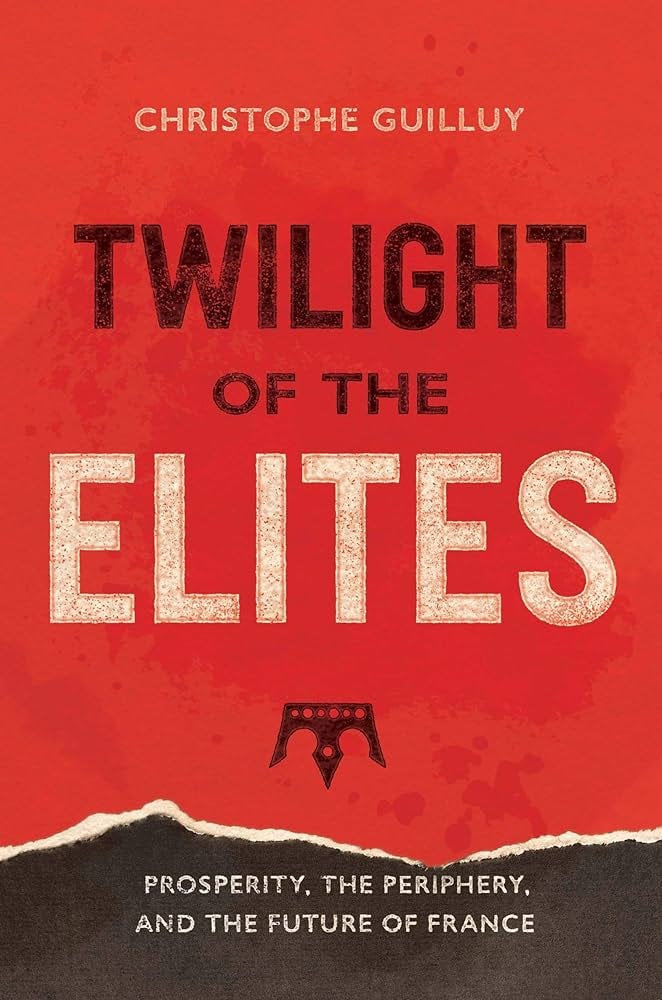
Now, I’ve been aware of Guilluy’s work for years. In 2021, I reached out to his editor at Yale University Press, which had published the English translation of his seminal French book La France périphérique (published as Twilight of the Elites in English). I felt that Guilluy deserved to have a lot more influence among American academic geographers. During 2020-21, I’d noted to myself that, despite Yale University Press translating his work, my colleagues in US geography departments were not taking the hint and making him a subject for discussion. I thought maybe organizing an event for Guilluy—inviting him to give a keynote lecture at a conference, something like this—could help. But I couldn’t get in touch with him. Unfortunately, the press editor would not give out Guilluy’s email, and Guilluy’s contact info was nowhere online (French academic norms are completely different when it comes to this kind of thing). At any rate, with no contact info, I moved on to other things, such as writing my third book.
Fast forward four years, to 2025, and I see that Guilluy is still considered an important figure. He’s considered important in Continental European academia and punditry, and also for the American political right, which identifies in Guilluy’s ideas a kind of economic-determinist (maybe even vaguely Marxian) legitimization of right-populist political currents.
So today I thought I would check on the degree to which four major Anglophone (and in particular US-based) academic geography journals have been acknowledging the existence of Christophe Guilluy! I wouldn’t expect that anyone’s published him directly, especially since he writes in French. But surely one of the major organs of a discipline called “Geography” has published someone who at least mentions Christophe Guilluy—since Guilluy is the most widely discussed academic geographer in years.
The results are much worse than I anticipated.
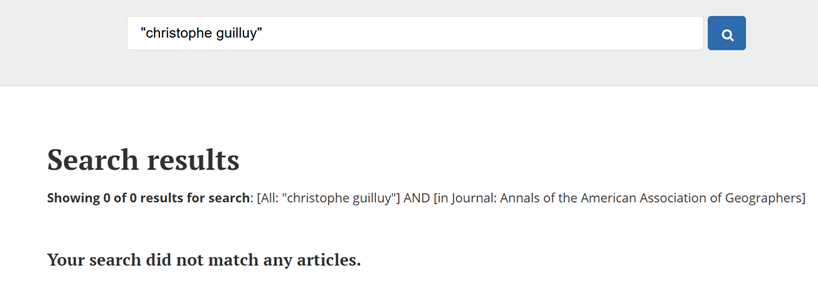
The discipline’s American flagship, the Annals of the American Association of Geographers, has never published anything or anyone acknowledging that Guilluy exists:
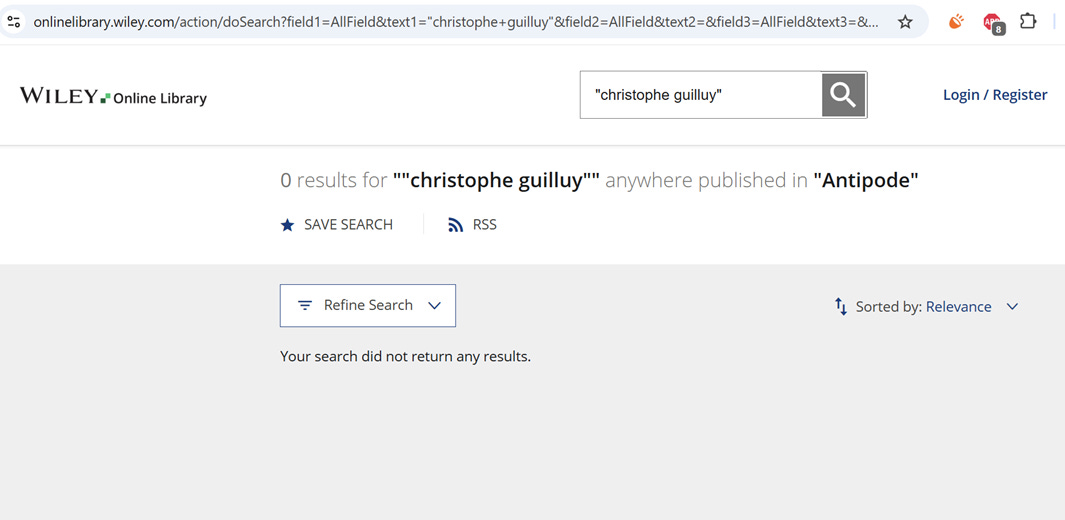
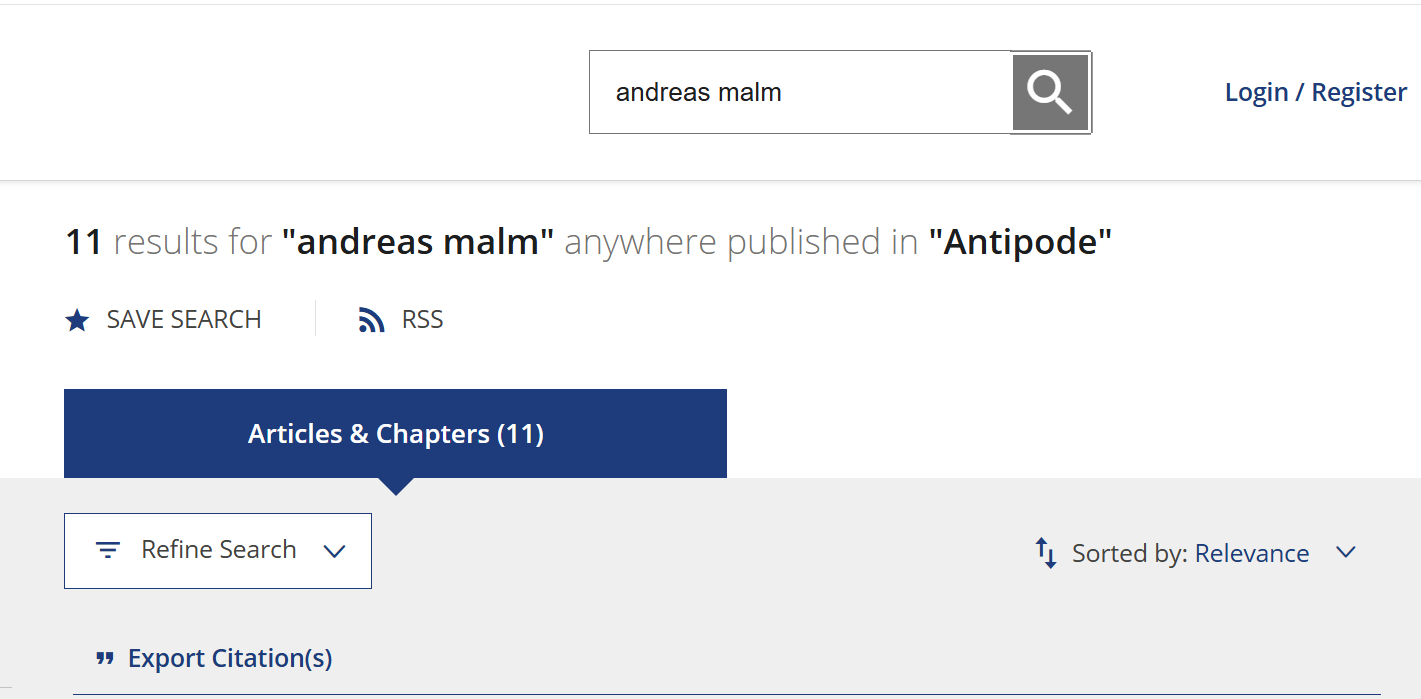
Antipode: A Journal of Radical Geography, which presents itself as keyed in to the major political debates of the age, has never published anything or anyone acknowledging that Guilluy exists:
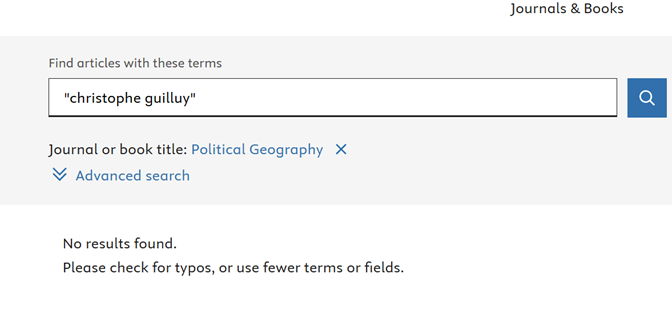
Political Geography, whose explicitly stated subject matter is supposed to include the kind of center-periphery relationships Guilluy is writing about and theorizing, does not acknowledge that Guilluy exists:
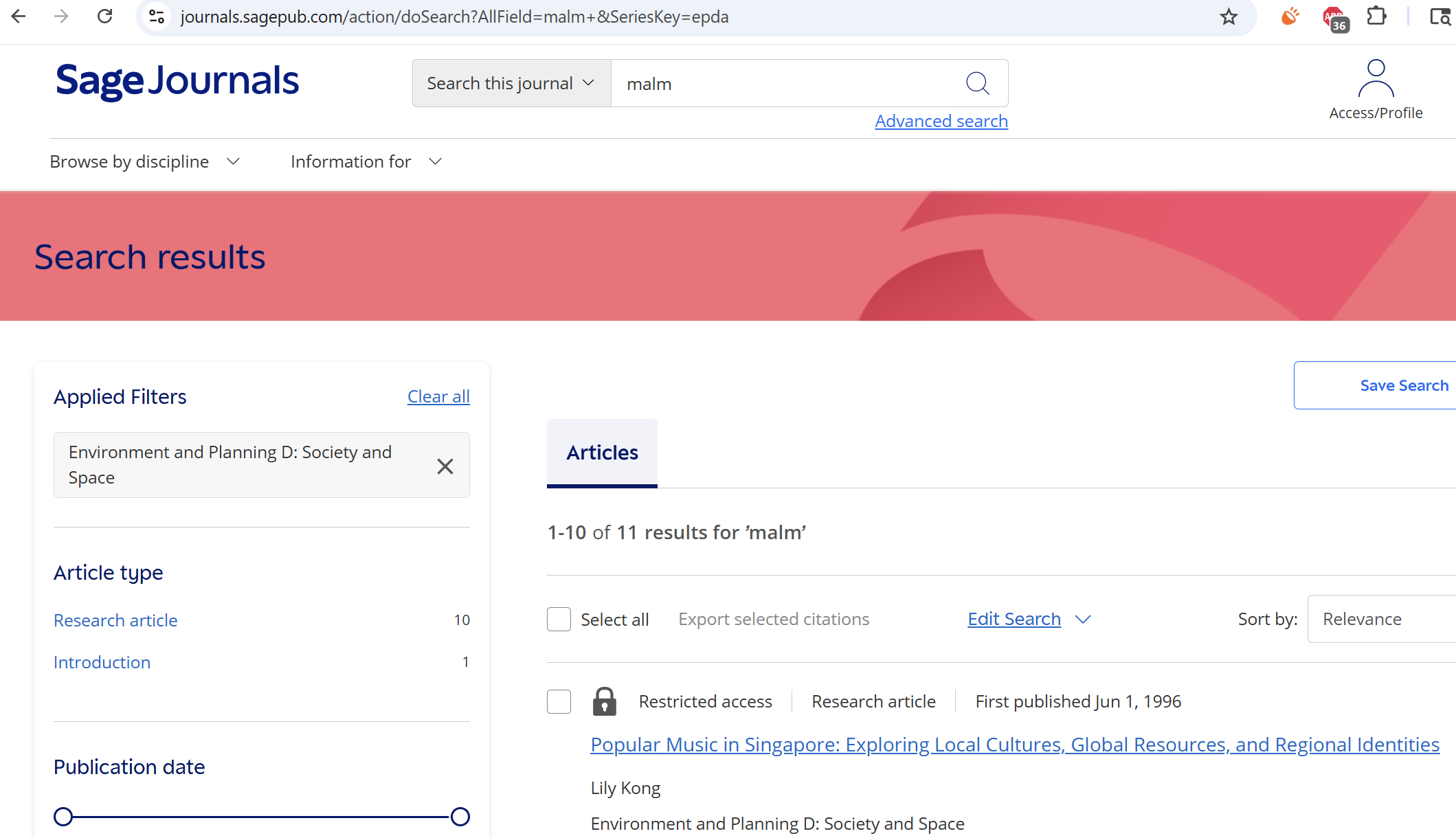
Another prestigious journal, Environment and Planning D, also seems completely unaware that Guilluy exists. Near as I can tell he’s never mentioned in any of the other Environment and Planning journals either (I think there are 7 or 8 at this point?).
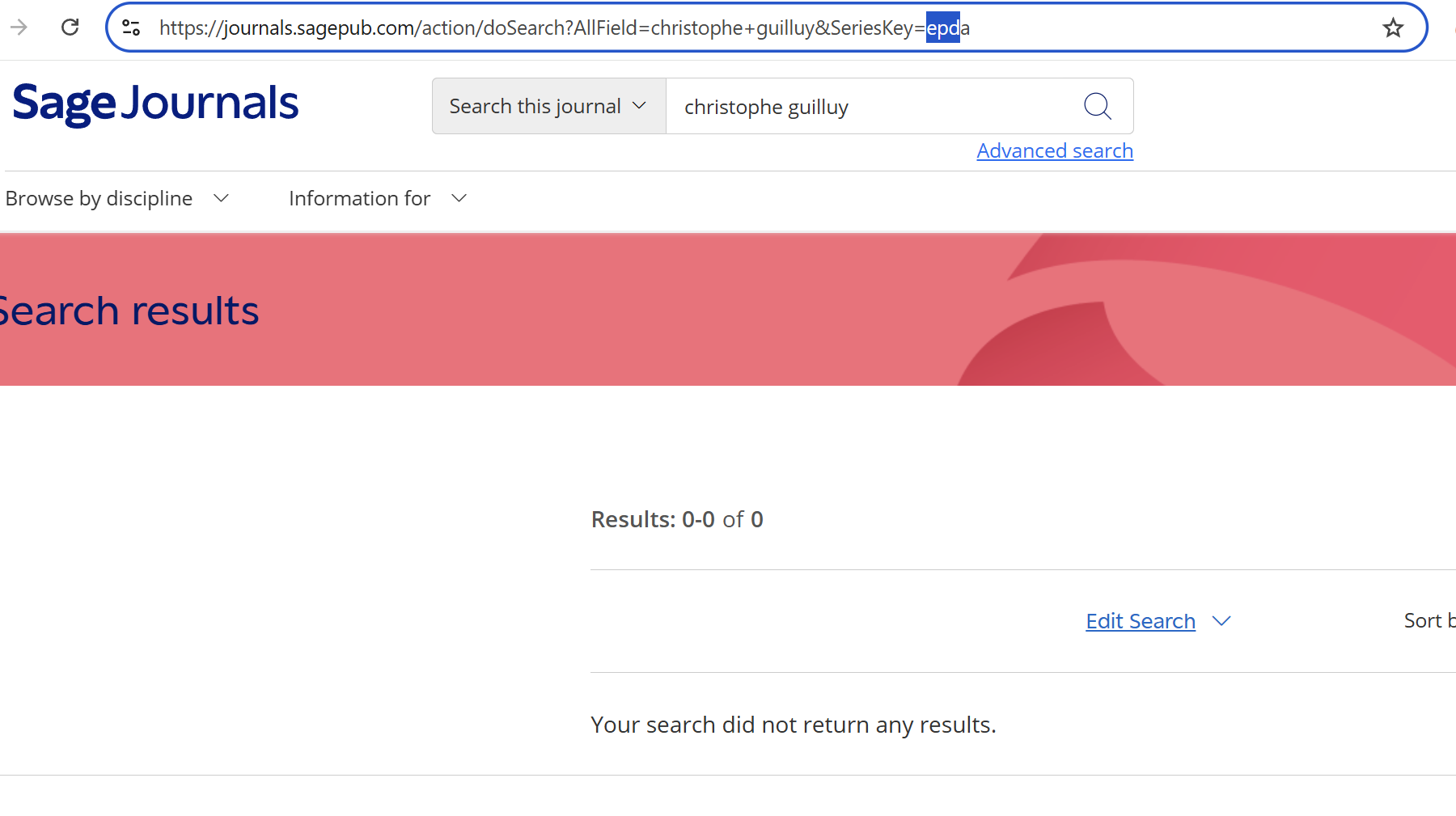
(For what it’s worth, I ran these searches in several ways, including just looking for the name “Guilluy” without the first name).
I am actually stunned by all those zeroes. Again: Guilluy is probably the most widely discussed academic geographer of the past 20 years whose name isn’t Jared Diamond (who, by the way, the reigning consensus-building regime in Anglophone academic geography dislikes quite a lot—but at least they acknowledge his existence and publish some attempts to grapple with his arguments). Ignoring Guilluy in the 2020s would be like ignoring David Harvey in the 1980s and 90s or ignoring Yi-Fu Tuan in the 1970s. Just a total refusal to face up to the logical paradigm shift, which ought to be talking about themes likes center-periphery conflicts as a driver of populism and nationalism (even if the discussion winds up implying that certain right-wing political parties in the Western world might be more politically up-to-date than certain center-left and left parties). This is how a discipline behaves when it’s deep, deep into intellectual zombie mode. So it’s going to be everyone else who talks about and analyzes the center-periphery socio-spatial dynamics driving populism and nationalism, but not academic geographers in the English-speaking world (who I guess just want to tell you for the billionth time that borders are fascist, police are demons, and the climate would have stopped changing if HRC had won).
This finding serves to demonstrate how Anglophone academic geography, including and especially the "radical" flavors which present themselves as engaged with the contentious political debates of the age, have become completely parochial and closed off from the rest of the world of ideas. They are not participating in dialectic. I don't know what the editors of Antipode, the Annals, E+D, Political Geography (and others!) think they exist for, if not to cultivate discussion about new important figures like Guilluy. I shouldn’t have to go to Tucker Carlson, of all places, to hear about him and his work!
Coda: A relatively new geographer who has been widely cited in Anglosphere geography publications is Andreas Malm, best known for his quasi-terroristic 2021 climate manifesto How to Blow Up a Pipeline. A geographer in Sweden, Malm did rather good scholarly work in the early 2010s about carbon pollution in China, but only became famous once he decided to never acknowledge this theme ever again, and instead advocate that Western countries sabotage their own energy infrastructure. Younger millennial and older Zoomer grad students have heard of Malm, but not of Guilluy.
Hmm. Great bunch of thoughts. Peer review is maybe best for keeping a check on normal science. Some of that has to happen. Editors of journals play a huge role in selecting reviewers and can get paradigm-shifting work through peer review. Enough stuff I've reviewed is counter-paradigm shift, unaware of key ideas and stuck in the past, doing "normal science" well past it's sell date. Peer review can keep that stuff away, or at least force the author to move the submission out of the past. 2015 paradigm that did not happen? I kind of thought that was the influx of DEI stuff, indigenous, gender, queer. All had been around for a while, but it seemed to coalesce around that point. I like peer review. Stinker reviewers are out there, but everything I've published has been made better by peer review. Even the somewhat atypical publications. But your general point is important. Christophe Guilluy! I'll look him up. Right-wing intellectual media is talking about other interesting thinkers (with their own spin) besides him. Suggests the "left" is behind and stale. Which may be your point. Woof. Caffeine.